
Loneliness and Mental Health: The Biology of Connection
Learn how loneliness and social isolation affect stress, sleep, emotional regulation, and mental health — and why human connections matters today globally.
PUBLIC MENTAL HEALTH
There’s a strange contradiction in modern life.
Many people today are constantly connected — replying to messages, attending meetings, scrolling through social media, reacting to stories — yet still describe feeling emotionally alone.
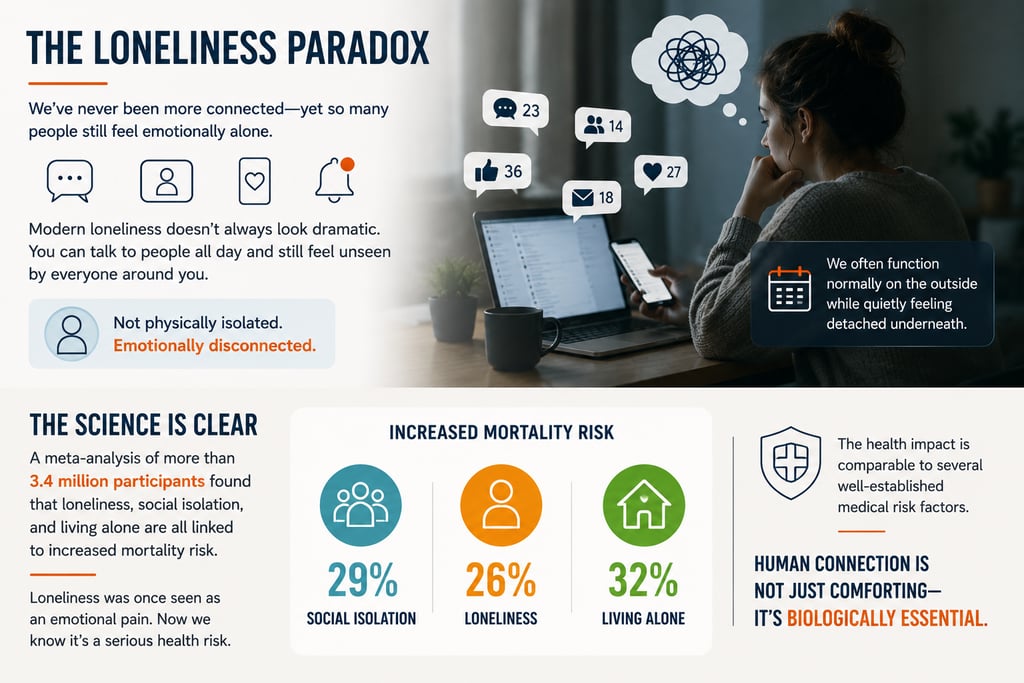
Not physically isolated.
Emotionally disconnected.
Modern loneliness often does not look dramatic from the outside. Sometimes it looks like functioning normally while quietly feeling detached underneath it all. A person may talk to people all day and still feel unseen by everyone around them.
For a long time, loneliness was treated mostly as an emotional experience — painful, but not medically important.
That understanding has changed significantly.
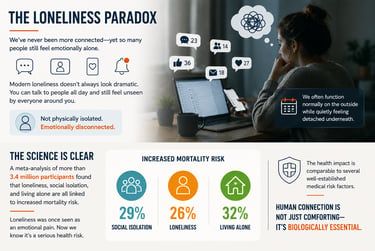
A large meta-analysis involving more than 3.4 million participants found that loneliness, social isolation, and living alone were all associated with increased mortality risk. The researchers reported that social isolation increased mortality risk by 29%, loneliness by 26%, and living alone by 32%.
The findings were serious enough that researchers compared the health impact to several well-established medical risk factors.
Human connection, it turns out, is not simply emotionally comforting.
The brain may treat it as biologically essential.
Quick Answer
Loneliness is not simply “feeling sad” or being introverted.
Modern research suggests chronic loneliness and social isolation can affect stress systems, sleep, emotional regulation, inflammation, cardiovascular health, and long-term mental well-being. Human beings appear deeply wired for connection, and prolonged emotional disconnection may place the brain and body into a more stress-sensitive state over time.
Loneliness and Social Isolation Are Not the Same Thing
One of the most important ideas in loneliness research is that being alone and feeling lonely are not always the same experience.
Some people live alone and feel emotionally fulfilled.
Others may be surrounded by people constantly yet still feel deeply disconnected internally.
The paper itself distinguishes between social isolation — the objective lack of social contact — and loneliness, which refers more to the subjective emotional experience of disconnection.
That distinction matters because the nervous system responds not only to physical reality, but also to perceived emotional safety and belonging.
A person can technically be surrounded by others and still feel psychologically unsupported, emotionally unsafe, unseen, or disconnected.
And over time, the brain appears to react to that experience biologically.
The Brain Treats Belonging as a Survival Signal
The human nervous system did not evolve for prolonged emotional isolation.
For most of human history, survival depended heavily on staying connected to a group. Protection, caregiving, food access, emotional regulation, and physical safety were deeply social experiences.
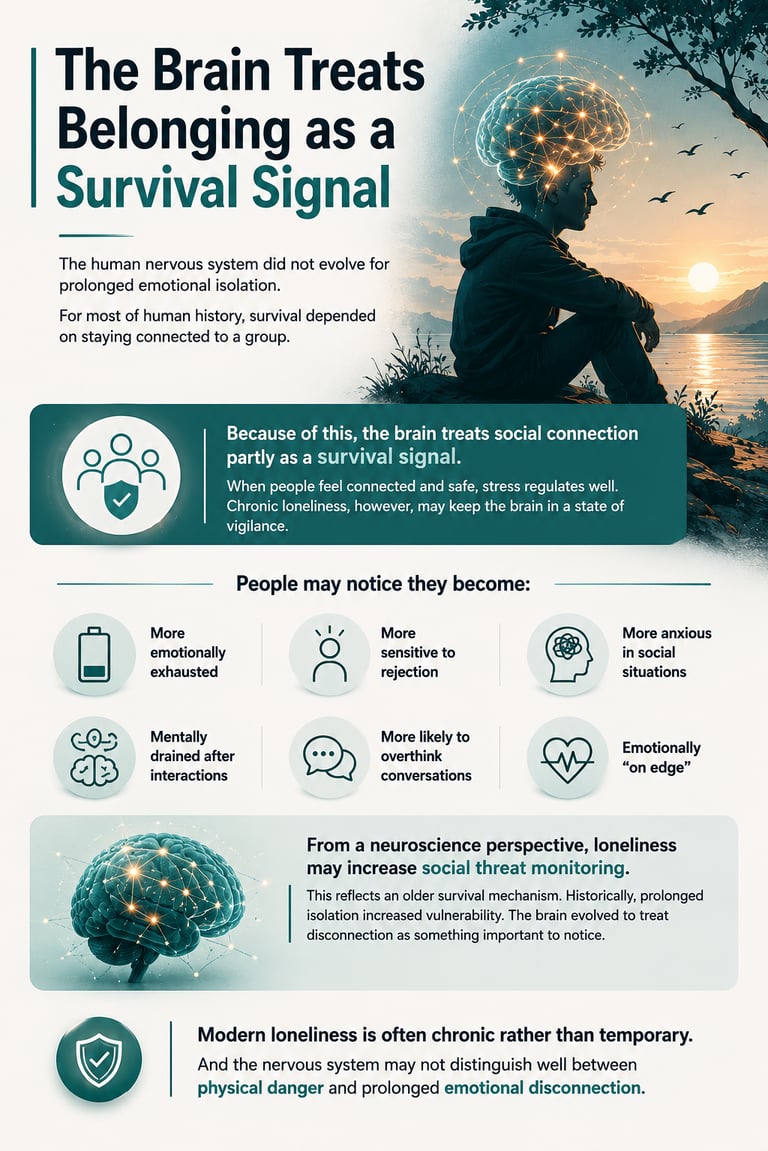
Because of this, researchers increasingly believe the brain treats social connection partly as a survival signal.
When people feel emotionally connected and socially safe, the nervous system tends to regulate stress more effectively. But when loneliness becomes chronic, the brain may gradually shift into a more vigilant state.
This does not necessarily happen consciously.
Instead, people may simply notice that they become:
more emotionally exhausted
more sensitive to rejection
more anxious in social situations
mentally drained after interactions
more likely to overthink conversations
emotionally “on edge”
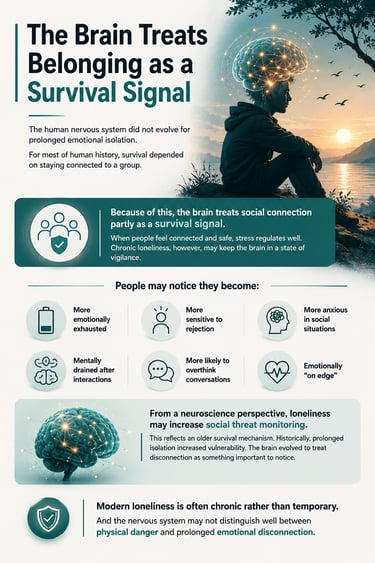
From a neuroscience perspective, loneliness may increase social threat monitoring.
Researchers believe this may reflect an older survival mechanism. Historically, prolonged isolation could increase vulnerability to danger. The brain therefore evolved to treat disconnection as something important to notice.
The problem is that modern loneliness is often chronic rather than temporary.
And the nervous system may not distinguish particularly well between physical danger and prolonged emotional disconnection.
Human Beings Regulate Stress Through Other People
One of the most overlooked aspects of mental health is that people do not regulate emotions entirely alone.
Human nervous systems constantly influence each other.
A calm voice, emotional reassurance, eye contact, predictability, trust, physical presence, and feeling emotionally understood all affect how safe the brain feels internally.
In neuroscience and attachment research, this is sometimes called co-regulation.
Safe relationships often help reduce stress responses automatically, without conscious effort.
This is one reason emotionally supportive relationships can improve:
emotional resilience
anxiety regulation
sleep quality
recovery from stress
overall emotional stability
And it may also explain why prolonged loneliness can feel physically exhausting rather than merely “sad.”
Without enough emotional safety or meaningful connection, stress systems may remain activated for longer periods.
Loneliness Changes Stress Biology
Many people notice that prolonged loneliness changes the way they think and feel.
Sleep becomes lighter.
Overthinking increases.
Motivation drops.
Small problems feel heavier than before.
This is likely not “just psychological.”
Research increasingly suggests loneliness may affect biological stress pathways involving:
cortisol regulation
autonomic nervous system activation
emotional vigilance
inflammatory signalling
In simpler terms, the brain may remain more alert and stress-sensitive when it experiences prolonged disconnection.
That chronic vigilance can gradually affect:
sleep quality
emotional regulation
concentration
energy levels
anxiety sensitivity
physical health behaviours
Over time, this may create a state that resembles emotional burnout.
Not necessarily intense sadness.
Sometimes just persistent emotional depletion.
Why Loneliness Can Affect Sleep So Strongly
Sleep and emotional safety are deeply connected.
The brain sleeps best when it perceives the environment as relatively safe and predictable.
Chronic loneliness may interfere with that process.
Some researchers believe socially disconnected individuals may remain in a lighter state of vigilance during sleep, contributing to:
fragmented sleep
poor sleep quality
emotional fatigue
reduced emotional resilience the next day
This creates a difficult cycle.
Know more about sleep issues, like insomnia here.
Poor sleep worsens emotional regulation and stress tolerance, which may then increase withdrawal, emotional exhaustion, and feelings of disconnection further.
This overlap is one reason loneliness frequently coexists with insomnia, burnout, anxiety, and depression.
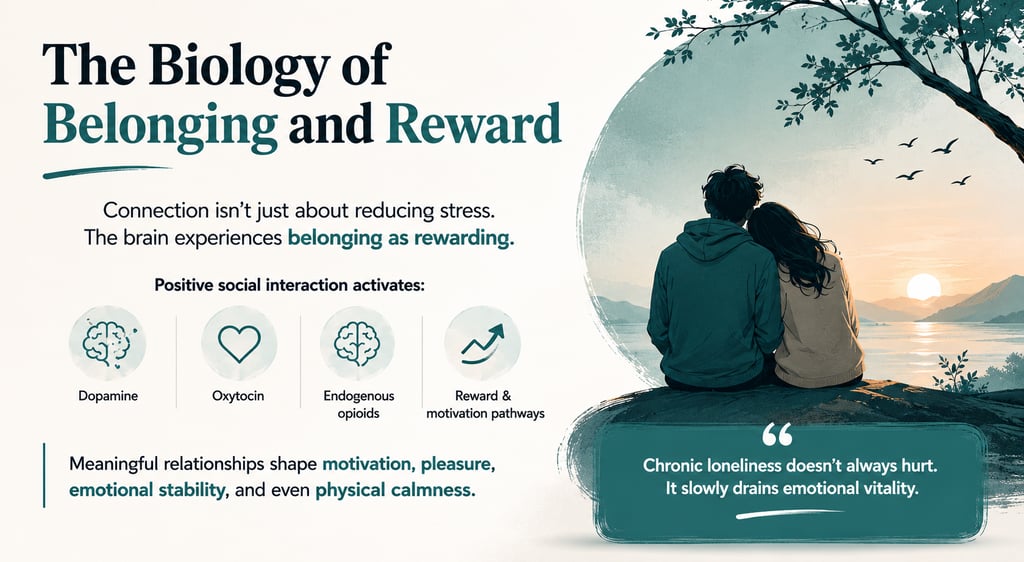
The Biology of Belonging and Reward
Connection is not only about reducing stress.
The brain also appears to experience belonging as rewarding.
Positive social interaction influences systems related to:
dopamine
oxytocin
endogenous opioids
reward and motivation pathways
Emotionally meaningful relationships can therefore influence motivation, pleasure, emotional stability, and even physical calmness.
This may partly explain why chronic loneliness sometimes creates feelings of numbness, emptiness, reduced motivation, or emotional flatness.
For some people, loneliness slowly begins to resemble emotional burnout.
Not acute pain necessarily.
Just a gradual fading of emotional vitality.
The Social Media Paradox
One of the strangest aspects of modern life is that people today often have more digital interaction than ever before — yet many still describe increasing loneliness.
Part of the issue may be that the brain distinguishes between exposure and genuine emotional connection.
Scrolling through social media creates stimulation, but not necessarily closeness.
For some individuals, constant comparison, passive consumption, or observing other people’s lives from a distance may actually increase feelings of exclusion or emotional disconnection.
This does not mean social media is inherently harmful.
Online spaces genuinely provide support and belonging for many individuals.
But emotionally meaningful connection usually involves something deeper than constant contact alone. The nervous system responds more strongly to emotional safety, trust, reciprocity, vulnerability, and feeling genuinely understood.
Those experiences are harder to reproduce through endless scrolling.
Loneliness Does Not Always Look Obvious
Many lonely people appear highly functional externally.
Some are professionally successful, socially active, constantly busy, or surrounded by people daily.
Yet internally, they may feel emotionally disconnected for years.
Modern adulthood sometimes unintentionally encourages this pattern. Long work hours, relocation, emotional exhaustion, burnout, remote work, digital communication, and weakening community structures may gradually reduce deeper forms of connection.
Sometimes people do not fully recognize their loneliness until symptoms begin appearing elsewhere:
fatigue
emotional numbness
worsening anxiety
low mood
poor sleep
emotional withdrawal
Loneliness often becomes visible indirectly.
The Link Between Loneliness, Depression, and Burnout
Loneliness rarely exists separately from mental health.
It often overlaps with depression, insomnia, anxiety, burnout, chronic stress, and emotional exhaustion.
Know more about depression and related problems here.
Sometimes loneliness contributes to these conditions.
Other times, mental health conditions themselves make connection harder. Depression can reduce motivation to socialize. Anxiety can increase fear of judgment or rejection. Burnout may leave people emotionally unavailable even to those they care about.
Over time, this can create a difficult cycle:
stress increases withdrawal
withdrawal deepens loneliness
loneliness worsens sleep and emotional regulation
emotional exhaustion increases further
Modern psychiatry increasingly recognizes these systems as interconnected rather than separate problems.
Why Loneliness Is Becoming a Public Health Concern
The researchers behind the meta-analysis argued that loneliness and social isolation deserve recognition as major public health concerns.
Years ago, that statement may have sounded exaggerated.
Today, it feels much easier to understand.
Modern life has created convenience, speed, and constant digital contact — but not always deeper belonging.
People are increasingly:
living alone
moving frequently
working remotely
spending more time online
participating less in long-term community structures
The result is that many people remain socially connected on the surface while emotionally disconnected underneath.
Rebuilding Connection Often Starts Smaller Than People Expect
When people hear “improve social connection,” they sometimes imagine becoming highly social or constantly surrounded by people.
But meaningful connection is usually less about quantity and more about emotional safety and consistency.
For some people, rebuilding connection may begin quietly:
reconnecting with one trusted person
spending less time in passive scrolling
joining spaces built around shared interests
allowing emotional openness gradually
improving sleep and emotional energy first
creating room for more emotionally honest conversations
Sometimes the hardest part is not finding people.
It is slowly relearning emotional openness after long periods of stress, burnout, disappointment, emotional self-protection, or disconnection.
Human Connection Is Not Just Emotional — It’s Biological
Modern culture often glorifies extreme independence.
But psychologically and biologically, human beings remain deeply relational.
Most people regulate stress more effectively when they feel emotionally safe, understood, and connected to others in meaningful ways.
That does not mean everyone needs large social circles.
And solitude itself is not unhealthy.
Healthy solitude and painful loneliness are very different experiences.
The problem is usually not occasional aloneness.
The problem is prolonged emotional disconnection without meaningful support, belonging, or closeness.
The brain appears to notice that absence more than we once realized.
Screening and Self-Assessment
Assess Depression Symptoms
👉 Take the PHQ-9 Depression Test to understand symptom severity and when professional support may help.
Assess Anxiety Symptoms
👉 Take the GAD-7 Anxiety Test to evaluate worry, restlessness, and physical symptoms of anxiety.
Assess Sleep Difficulties
👉 Take the Insomnia Severity Index (ISI) to understand whether sleep problems may be affecting mood and emotional functioning.
Common Questions About Loneliness and Mental Health
Is loneliness really bad for physical health?
Research suggests chronic loneliness and social isolation are associated with poorer physical health outcomes and increased mortality risk.
Can someone feel lonely even with friends or relationships?
Yes. Loneliness is subjective. Some people feel emotionally disconnected despite frequent social interaction.
Why does loneliness affect sleep and anxiety?
Loneliness may increase stress sensitivity and emotional vigilance, which can affect emotional regulation, overthinking, and sleep quality over time.
Is social media causing the loneliness epidemic?
Social media is not inherently harmful, but passive digital interaction sometimes fails to provide the emotional closeness and belonging the brain often needs.
Reviewed by Dr. Mahendra Singh Uikey, MBBS, MD Psychiatry (AIIMS Delhi)
Consultant Psychiatrist | AIIMS-trained
Providing evidence-based psychiatric care
This article is for educational purposes and does not replace professional medical advice.
Contact
Reach out for support and appointments
care@psyconnect.in
©2026. All rights reserved.
Confidential. Evidence-based. Ethical psychiatric practice.
If you are in crisis or having thoughts of self-harm or suicide, please reach out right away. Support is free, confidential, and available 24/7.
Tele-MANAS (Government of India): 14416 or 1-800-891-4416 — available in English and 20 regional languages
ICall (TISS): 9152987821 — counselling support by trained professionals
AASRA: 9820466726 — 24/7 crisis support
Emergency: Contact your nearest hospital or call 112
IMMEDIATE SUPPORT
+91 82877 12625 (Reception)