
Psychologist vs Psychiatrist: Key Differences Explained (India)
Confused about who to see — a psychologist or a psychiatrist? A Delhi-NCR psychiatrist breaks down the difference so you can choose the right first step.
PUBLIC MENTAL HEALTH
One of the most common questions I receive from patients and their families is: "Should I see a psychiatrist or a psychologist?"
It is a reasonable question — and an important one. In India, the two professions are frequently confused, and many people end up either delaying care or consulting the wrong specialist for their specific concern. This article explains the key differences clearly, so you can make an informed decision about your mental health care.
The Core Difference: Medical vs. Non-Medical Training
The most fundamental distinction between a psychiatrist and a psychologist lies in their educational background and medical training.
Psychiatrist
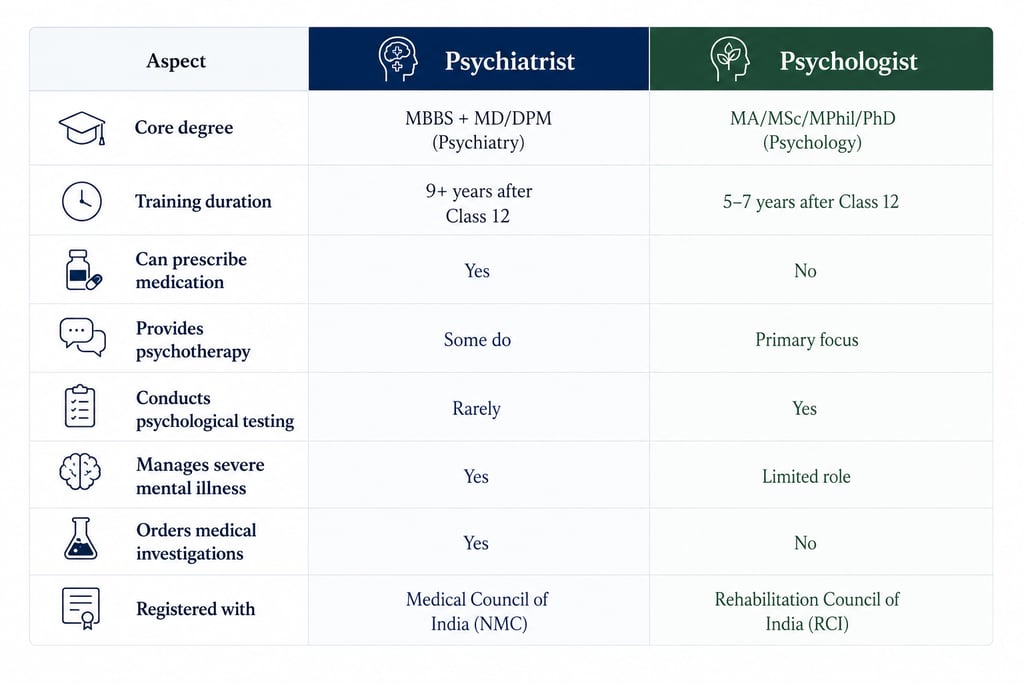
A psychiatrist is a medical doctor (MBBS) who has completed a postgraduate specialisation in psychiatry — either an MD (Doctor of Medicine) in Psychiatry or a Diploma in Psychological Medicine (DPM). In India, this means a minimum of nine years of medical education and clinical training after Class 12.
Because psychiatrists complete a full medical degree first, they are trained to:
Diagnose mental health conditions using clinical and biological frameworks
Prescribe and manage psychiatric medications
Order and interpret investigations such as blood tests, brain scans, and EEGs
Identify physical or neurological conditions that may be causing or worsening mental health symptoms
Manage medically complex or severe cases requiring hospitalisation
Psychologist
A psychologist holds a postgraduate degree in psychology — typically an MA, MSc, or MPhil in Clinical Psychology, or a PhD. In India, a Rehabilitation Council of India (RCI)-recognised qualification in clinical psychology is the standard for practice.
Psychologists are trained to:
Conduct psychological assessments and psychometric testing
Provide structured psychotherapy (talk therapy)
Understand human behaviour, cognition, and emotion
Work with individuals, couples, families, and groups
Crucially, psychologists in India cannot prescribe medications. This is one of the most important practical differences between the two professions.
Key Differences at a Glance
What Does a Psychiatrist Treat?
Psychiatrists are the appropriate specialists for conditions that have a significant biological component, require medication, or involve severe symptoms. These include:
Depression — especially moderate to severe, or treatment-resistant cases
Anxiety disorders — Generalised Anxiety Disorder, Panic Disorder, Social Anxiety
Bipolar Disorder — requires mood stabilisers and careful monitoring
Obsessive-Compulsive Disorder (OCD) — often requires both medication and therapy
Schizophrenia and psychotic disorders — require antipsychotic medication
ADHD — diagnosis and medication management in children and adults
Addiction and substance use disorders — including alcohol, opioids, and other substances
Eating disorders — particularly when medically compromised
Sleep disorders — insomnia, hypersomnia, and sleep-related conditions
Dementia and neurocognitive disorders
Postpartum psychiatric conditions
What Does a Psychologist Do?
Psychologists focus primarily on psychological assessment and structured psychotherapy. They are well-suited for (but not limited to):
Mild to moderate depression and anxiety — where medication may not be immediately required
Cognitive Behavioural Therapy (CBT) — for anxiety, OCD, depression, phobias
Relationship and interpersonal difficulties
Grief, adjustment problems, and life transitions
Psychological assessment — IQ testing, personality assessment, learning disability evaluation
Child and adolescent behavioural issues — where a psychological approach is preferred
Stress management and coping skills
Do Psychiatrists Provide Therapy Too?
Yes — many psychiatrists are trained in psychotherapy and integrate it into their clinical practice. At PsyConnect, consultations are not limited to medication management. Treatment planning incorporates psychoeducation, behavioural strategies, and therapeutic guidance alongside pharmacological treatment where needed.
However, intensive, weekly psychotherapy sessions are typically the domain of psychologists or trained psychotherapists who have dedicated time for this purpose.
Can a Psychiatrist and Psychologist Work Together?
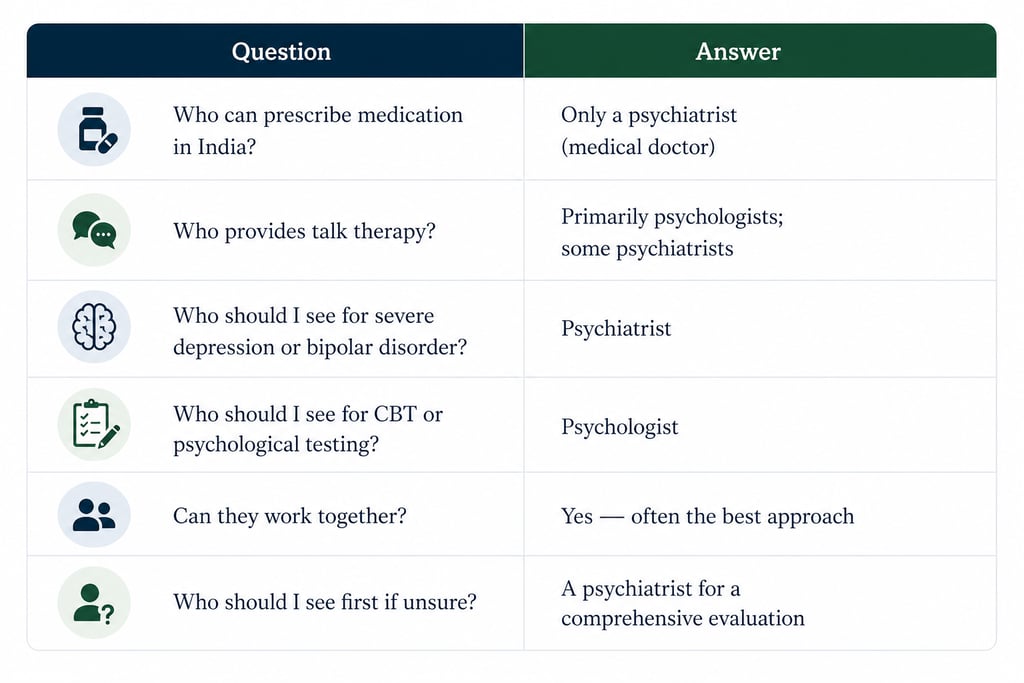
Absolutely — and this is often the most effective approach. For many conditions, particularly depression, anxiety, OCD, and PTSD, a combination of medication (managed by a psychiatrist) and structured psychotherapy (provided by a psychologist) produces better outcomes than either treatment alone.
This collaborative model is standard practice in well-organised mental health care systems, and something I encourage when clinically appropriate.
Who Should You See First in India?
This depends on your symptoms and their severity. Here is a practical guide:
See a Psychiatrist first if:
Your symptoms are severe or significantly affecting your daily functioning
You have been experiencing symptoms for a prolonged period without improvement
You may need medication to stabilise your condition
You have previously been diagnosed with a psychiatric condition
You are experiencing psychosis, mania, or suicidal thoughts
You want a comprehensive clinical diagnosis before starting any treatment
A previous psychologist or counsellor has recommended psychiatric evaluation
A Psychologist may be appropriate if:
Your symptoms are mild and you prefer a non-medication approach initially
You are looking for specific structured therapy (e.g. CBT for a phobia)
You need psychological testing or assessment
You are dealing with relationship, career, or adjustment difficulties without a clinical diagnosis
When in doubt — start with a psychiatrist. A psychiatrist can assess whether medication is needed, refer you to a psychologist for therapy if appropriate, and coordinate your overall care. A psychologist cannot prescribe medication or manage medically complex presentations.
A Common Misconception in India
Many people in India believe that seeing a psychiatrist means you are "seriously ill" or that the consultation will automatically result in being put on medications. This is not the case.
A psychiatric consultation is a clinical evaluation — the outcome may be reassurance, psychoeducation, a referral for therapy, lifestyle guidance, or medication, depending entirely on what your clinical picture warrants. Many patients are seen and managed without any medication at all.
The stigma around psychiatry in India leads to delayed care, which in turn leads to more severe illness. Seeking help early — from the right specialist — leads to better outcomes.
Counsellors and Therapists: Where Do They Fit?
In India, the terms "counsellor" and "therapist" are not legally protected titles. Many practitioners use these terms without standardised qualifications. While there are highly skilled counsellors and therapists doing valuable work, it is important to verify the qualifications of anyone you consult for mental health support.
When seeking help for a clinical mental health condition — one that is causing significant distress or impairment — it is advisable to consult a psychiatrist or a registered clinical psychologist (RCI-recognised) rather than an unregistered counsellor.
Summary
Consult Dr. Mahendra Singh Uikey
Dr. Mahendra Singh Uikey is an AIIMS-trained Consultant Psychiatrist providing evidence-based psychiatric care online and in-person across Delhi-NCR, Gurgaon, and pan-India.
If you are unsure where to start, a psychiatric consultation will help clarify your diagnosis and guide you toward the most appropriate treatment — whether that involves medication, therapy, or both.
This article is written for informational purposes and does not constitute medical advice. Please consult a qualified psychiatrist for personalised diagnosis and treatment.
© PsyConnect | Dr. Mahendra Singh Uikey | care@psyconnect.in
Contact
Reach out for support and appointments
care@psyconnect.in
©2026. All rights reserved.
Confidential. Evidence-based. Ethical psychiatric practice.
If you are in crisis or having thoughts of self-harm or suicide, please reach out right away. Support is free, confidential, and available 24/7.
Tele-MANAS (Government of India): 14416 or 1-800-891-4416 — available in English and 20 regional languages
ICall (TISS): 9152987821 — counselling support by trained professionals
AASRA: 9820466726 — 24/7 crisis support
Emergency: Contact your nearest hospital or call 112
IMMEDIATE SUPPORT
+91 82877 12625 (Reception)